Agricultural AI Training Platform for Industry-Education Integration

Build a practical smart-agriculture AI training center for vocational institutions

Escher provides vocational institutions with an integrated platform for agricultural digital twins, AI agents, course resources, and training assessment, helping schools bring real industry scenarios into the classroom.

4digital-twin industry scenarios
32+standardized training tasks
3layers of teaching, training, and enterprise collaboration access
70%standard modules plus configurable delivery

Agricultural Digital Twin AI Training CockpitTraining sync
Virtual GreenhouseClimate ControlAI Teaching AssistantQ&A and ReviewTask Work OrdersTraceable OperationsCapability ProfilesProcess Evaluation
ReplayableanomalyCourseresourcesProjectapplications
Institutional Needs

Vocational institutions do not need another slide deck. They need a real training system that can support broader program-cluster development.

Modern agriculture is moving from experience-driven management to data-driven operations, and agriculture-related majors need upgraded training conditions as well. The platform supports classroom teaching, project training, competitions, social training, and employability development.

Smart agriculture training system capability map
High cost barrier01

High investment

Greenhouses, processing lines, and smart equipment are expensive, so most institutions struggle to give every student enough practice time.


Scenario Reproduction Challenge02

Hard to reproduce

Critical scenarios such as pest outbreaks, extreme weather, or processing-quality exceptions occur sporadically and are hard to reproduce in class.

Evaluation03

Missing process records

Traditional training often focuses only on final results, while parameter choices, decision logic, and troubleshooting paths are not fully recorded.

Industry-Education Integration04

Hard to integrate

Schools need to turn real enterprise operations into courses, work orders, grading rules, and reusable teaching outcomes.

Platform Architecture

Integrated platform capabilities built on real industry data, linking courses, training, and assessment

With digital twins and AI at the core, the platform organizes greenhouse space, sensors, work records, course tasks, and student capability assessment into reusable teaching assets.
Agricultural AI training platform architecture
One foundation

3DGS digital twin + AI agents + data governance

Used for real-scene reconstruction, parameter simulation, anomaly drills, and industry case accumulation.

Two centers

Teaching and training center + industry case center

Designed for classroom practice, project-based learning, enterprise case reviews, and regional showcase use cases.

Three systems

Teacher portal, student portal, and training assessment system

Teachers assign tasks and trigger scenarios, students execute work orders, and the system generates process-based evaluation.

Four resource sets

Course packs, task packs, case library, and assessment reports

Forms reusable, extensible, and continuously updated teaching assets.

Training Scenarios

Break the agricultural value chain into training modules that schools can teach, compete with, and use in applications

The platform supports flexible deployment based on program clusters and existing campus facilities. Schools can start with one core training scenario or expand into a comprehensive center covering cultivation, post-harvest, operations, quality control, and regional industry services.

Core scenario

Controlled-environment agriculture digital twin and climate-control training

For controlled-environment agriculture, modern agriculture, horticulture, and IoT majors.

  • Greenhouse modeling, sensor mapping, and climate parameter calibration
  • Growth simulation for flowers, blueberries, vegetables, and other protected crops
  • AI alert interpretation plus supplemental light, fertigation, and temperature-humidity strategy drills
  • Outputs control strategy sheets and anomaly review reports
AIoT foundation

Farm agent and device-operations training

Turns Nongxiaoxin into an agriculture-specific teaching foundation for IoT and intelligent manufacturing.

  • Device onboarding, alert handling, task orchestration, and field troubleshooting
  • Coordinated training for edge boxes, gateways, cameras, and actuators
  • Outputs O&M logs, work orders, and device health reports
Cross-discipline sharing

Post-harvest grading, traceability, and supply-chain collaboration training

Connects agriculture, logistics, e-commerce, quality management, and data-analysis majors.

  • Grading and traceability for flowers, blueberries, vegetables, and other agri-products
  • Simulation of packaging, cold chain, loss, and fulfillment processes
  • Outputs grading sheets and business-analysis reports
Focus Area
Core Product Modules
Matched Courses
Assessment Outputs
Controlled-environment agriculture
Virtual greenhouse, crop growth models, climate-control agent, and post-harvest collaboration
Protected horticulture, smart agriculture, modern agriculture, and IoT applications
Climate-control strategies, anomaly-handling reports, and project presentation materials
Medicinal crops
Planting digital twins, seed/spawn quality assessment, disease recognition, processing QA drills, and knowledge-graph AI teaching assistants
Standardized medicinal-crop cultivation, medicinal-crop processing and quality control, and medicinal-crop AI data analysis
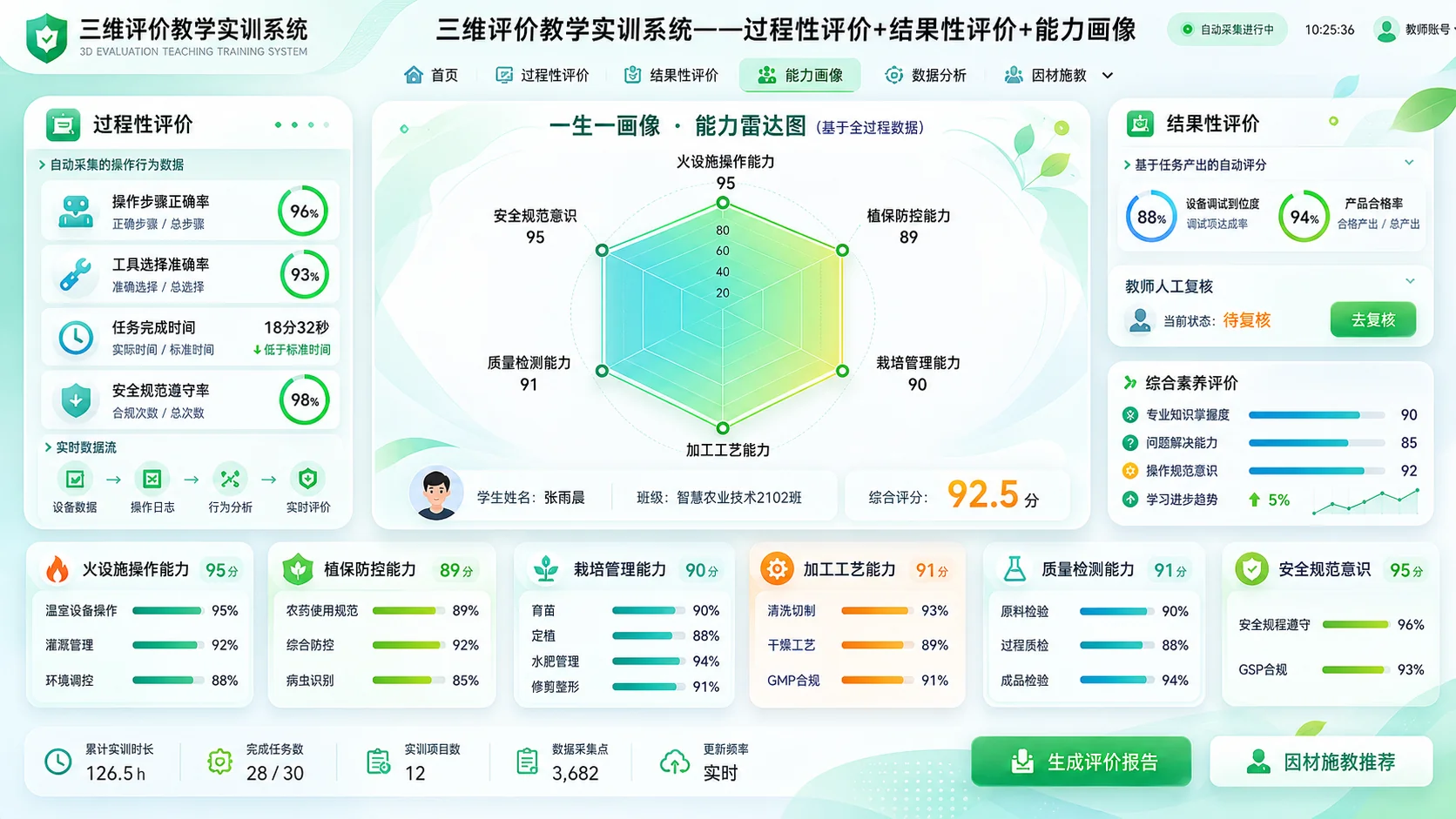
Quality grading, disease assessment, processing parameter reports, and student capability profiles
Regional industry-education integration
Industry case library, showcase dashboard, teacher-side management, and social-training task library
Shared course clusters, extracurricular programs, dual-mentor projects, and enterprise staff training
Course coverage, trainee count, utilization rate, and application-support materials
Teaching Loop

The task system progresses by capability, helping students move from understanding to judgment

Each training task is designed around real job capabilities, covering knowledge, standard operations, parameter decisions, and anomaly handling, so teachers can record the full learning journey.

01

Cognitive

Learn the industry chain, equipment objects, crop stages, workflows, and key quality indicators.

02

Operational

Execute SOPs, complete device integration, parameter setup, image labeling, and processing-flow simulation.

03

Decision-making

Adjust climate, fertigation, pest control, or processing parameters and observe changes in yield, quality, and cost.

04

Troubleshooting

Handle device exceptions, disease risks, quality fluctuations, and order-collaboration issues, then generate review reports.

Implementation Options

Three implementation tiers for stages from course pilots to provincial demonstration bases

Based on a school's existing greenhouses, labs, program-cluster goals, and industry-education targets, the platform provides tiered options from course pilots to comprehensive bases.

Light pilot edition

Launch one AI training course first

Quick start

Suitable for secondary vocational schools, standard colleges, and first-time pilot departments.

  • SaaS platform accounts and case-data packs
  • Basic sensing kits and teaching work orders
  • Teacher training and demo-class support
Standard training edition

Build an on-campus digital-twin training center

Standard buildout

Suitable for top-tier institutions, program-cluster initiatives, and campus-base upgrades.

  • Digital-twin training pods or greenhouse retrofits
  • Gateways, control systems, course packs, and assessment packs
  • Operations services and project showcase dashboards
Flagship base edition

Build a regional industry-education demonstration base

Joint operations

Suitable for provincial demonstration schools, vocational universities, and industry-education alliances.

  • School-enterprise co-built productive training base
  • Regional case library and enterprise work-order integration
  • Joint certification, competitions, and social-training operations
Expected Outcomes

Make the training center truly serve teaching, program development, and regional industry

Smart agriculture training center illustration
95%+student participation target
70%+per-student training cost reduction target
3xeffective training-hours target
4-6school-enterprise digital textbook target
Service Support

From solution design to classroom rollout, help schools make the platform usable and durable

Escher provides hardware-software integration, course resources, faculty training, data security, and continuous O&M services to lower the barrier to adoption.
01

Current-state diagnosis

02

Solution design

03

Platform delivery

04

Faculty training

05

Continuous operations

Teaching platform dashboard

Course resources delivered with the platform

Teaching-ready

Provides slide decks, task sheets, operation manuals, scoring rules, and student report templates so teachers can organize classes quickly.

Supports retrofits of existing greenhouses and labs

Manageable deployment

Can be deployed according to the school's existing site, equipment, and network conditions to reduce repeated investment.

Case library and AI capabilities keep evolving

Continuously updated

The platform can continuously add new crops, devices, diseases, processes, and industry cases to support long-term program development.

Book a Consultation

Start with one demonstration course and build the school's own smart-agriculture AI training center

Book a platform demo. We will combine your program direction, existing training conditions, and build goals to recommend matching scenarios and rollout paths.

  • For school leadership: application-ready, showcase-ready, and capable of producing flagship outcomes.
  • For departments: suitable for courses, practical training, competitions, and program-cluster development.
  • For teachers: low maintenance, reusable, and able to generate assessment reports automatically.
WeChat support QR code

Scan QR codeContact us on WeChat

By submitting, you agree that we only use this information for business communication and will not disclose specific operational data.